Noorani Qaida vs. Noor Al-Bayan: Which Reading Method Is Best for Your Child?
Reading Curriculum Takeaways
- Noorani Qaida is unmatched for non-Arabic speakers needing individual phonics, makhraj drilling, and rhythmic cadence.
- Noor Al-Bayan accelerates transition directly into the Holy Mushaf through rapid syllable synthesis.
- Young toddlers (ages 3.5 to 6) usually thrive better with the step-by-step pace of Noorani Qaida.
- Our faculty pairs the right curriculum to each child after a diagnostic evaluation in the free trial class.
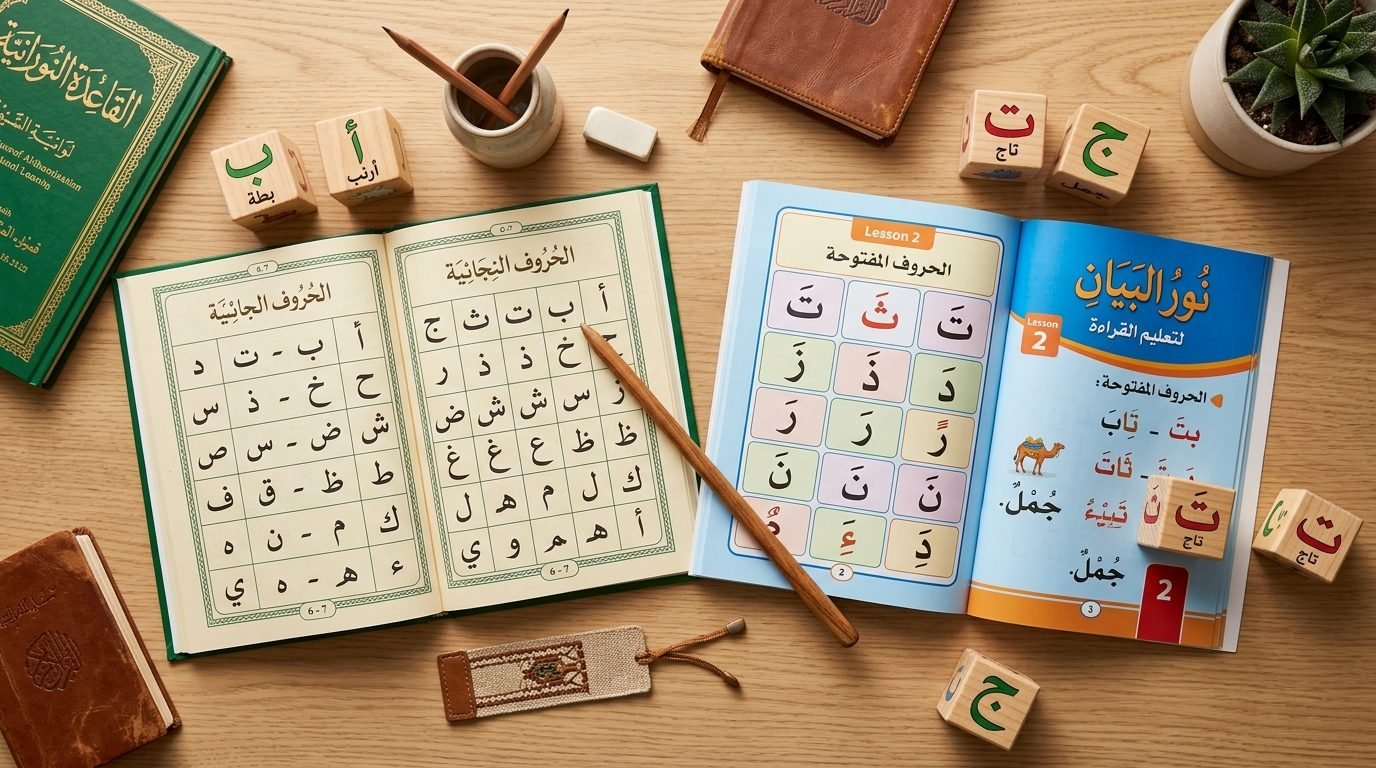
When Muslim parents decide to teach their children how to read the Holy Quran, they almost always encounter two dominant, world-renowned curricula: **Noorani Qaida (القاعدة النورانية)** and **Noor Al-Bayan (منهج نور البيان)**.
Both methods have successfully guided millions of children and adult learners to recite the words of Allah with clarity and Tajweed. However, each curriculum was engineered with a different pedagogical philosophy, learning pace, and target student in mind.
Choosing the right curriculum for your child's specific background—especially for children growing up in non-Arabic speaking environments like the UK, USA, Canada, or Australia—can mean the difference between a joyful, effortless journey and months of frustrating confusion.
Here is the authoritative head-to-head breakdown from the academic faculty at Qumra Academy:
1. What is Noorani Qaida? (The Phonics & Spelling Pioneer)
Originated by Sheikh Noor Muhammad Al-Haqqani, the **Noorani Qaida** is the most widely practiced foundational book in South Asia, the West, and international Islamic schools.
**Key Pedagogical Features:**
- **Letter-by-Letter Spelling (Tahajji):** Children learn the individual names of letters before vowel sounds. For example, rather than reading *Ka-Ta-Ba* immediately, they deconstruct: *Kaf Fathah "Ka", Ta Fathah "Ta", Ba Fathah "Ba" -> Kataba*.
- **Rhythmic Musical Cadence:** Lessons are recited in a melodious, chanting rhythm that children find hypnotic and easy to memorize.
- **Micro-Focus on Makharij (Articulation Points):** Extreme attention is paid to tongue and throat positions before advancing to words.
**Best Suited For:**
- Young toddlers (ages 3.5 to 6) who benefit from slow, rhythmic auditory repetition.
- Non-Arabic speaking families where parents cannot converse in Arabic at home.
2. What is Noor Al-Bayan? (The Direct Quranic Immersion)
Developed in Egypt and deeply rooted in Al-Azhar methodology, **Noor Al-Bayan** is celebrated across the Arab world and progressive international academies for its rapid, comprehensive transition into full Quran recitation.
**Key Pedagogical Features:**
- **Rapid Syllable Synthesis:** Instead of spelling each letter name, children immediately connect sound gestures (*Harakah*) to form syllables (*Ba, Bi, Bu*), advancing directly into multi-syllable Quranic words.
- **100% Mushaf Vocabulary:** Every single practice word and sentence is drawn directly from authentic Quranic script (Rasm Uthmani), eliminating any disconnect between the textbook and the Holy Quran.
- **Embedded Tajweed Rules:** Lessons introduce Madd (elongations), Sukun, Shaddah, Tanween, and Ghunnah organically through practical recitation rather than dry grammar rules.
**Best Suited For:**
- Children ages 6 and older who can grasp phonetic blending quickly.
- Students who want to transition into reciting full Ayahs in the shortest possible timeframe.
3. Head-to-Head Comparison
| Feature | Noorani Qaida (القاعدة النورانية) | Noor Al-Bayan (منهج نور البيان) |
|---|---|---|
| **Origin & Tradition** | Indian Subcontinent & Global Madrasahs | Egypt & Al-Azhar Academic Pedagogy |
| **Core Method** | Spelling letters by name (Huroof Tahajji) | Rapid phonetic blending of syllables |
| **Pacing** | Gradual, repetitive, and deliberate | Fast-paced, comprehensive, and immersive |
| **Target Age Group** | Best for ages 3.5 to 6 years | Best for ages 6 to 14+ and adults |
| **Tajweed Integration** | Emphasizes Makharij and sound articulation | Emphasizes practical Quranic rules and Madd |
| **Transition to Quran** | Requires an extra bridging step | Direct transition into the Holy Mushaf |
4. How Qumra Academy Customizes the Syllabus for Your Child
At Qumra Academy, we do not believe in a one-size-fits-all approach. During your child's **100% Free 1-on-1 Trial Lesson**, our certified Al-Azhar instructor conducts a friendly oral diagnostic:
- **Assessing Native Language Exposure:** If the child speaks only English at home, we often utilize Noorani Qaida's phonetic precision to build unshakeable letter recognition.
- **Matching Visual & Auditory Learning Styles:** If your child is eager to read stories and full words quickly, we introduce the vibrant exercises of Noor Al-Bayan.
- **Continuous Tracking:** Regardless of the curriculum chosen, your child receives verified one-on-one attention with regular progress reports delivered straight to your WhatsApp.
Common Questions & Expert Guidance
Did you find this practical guide helpful?
Qumra Academy Academic Council
All educational and Tajweed guides are authored and verified by certified instructors holding verified Ijazahs with connected Sanad.
Ready to Start a Personalized 1-on-1 Track?
Book a 100% Free Trial Class with a certified Al-Azhar instructor. Get a personalized assessment and tailored feedback.
Related Guides You May Enjoy

3 Tajweed Mistakes Every Learner Should Avoid (And How to Fix Them)
A practical, step-by-step guide to mastering Qalqalah, heavy vs light letters, and proper Ghunnah without nasal air leakage.
Read Guide
How to Build a Consistent Daily Quran Habit for Kids (Without the Struggle)
A compassionate guide for Muslim parents in the West: how to turn Quran time from a daily negotiation into an eagerly anticipated family ritual.
Read Guide
The 20-Minute Quran Memorization Blueprint for Busy Working Adults
How working professionals, university students, and busy parents can memorize the Holy Quran consistently with zero overwhelm using the spaced repetition method.
Read Guide